Ask someone to describe their workout routine and you’ll hear about cardio, maybe some weights, possibly a stretching habit. Almost nobody mentions balance. It doesn’t build visible muscle, it doesn’t raise your heart rate, and it doesn’t come with a number you can track on an app — so it quietly gets left off the list, right up until the day it matters most.
That’s a genuine gap, because balance turns out to be one of the more consequential fitness capacities most people never train on purpose.
In This Article
The Research Behind the 10-Second Stance
As covered in 5 Simple Tests That Reveal How Resilient Your Body Really Is, a study following more than 1,700 adults ages 51 to 75 in Brazil found that the ability to hold a simple 10-second single-leg stance correlated meaningfully with long-term health outcomes over more than a decade of follow-up — even after accounting for age, sex, body composition, and existing health conditions. That’s a striking finding for a test that costs nothing and takes less than a minute to try.
This piece goes deeper into why that particular capacity behaves so differently from the other markers covered in the pillar article, and what an actual, structured balance practice looks like — not just the single test, but a real progression you can build over weeks and months.
Why Balance Declines Differently Than Strength or Cardio
Strength and cardiorespiratory fitness tend to decline gradually and fairly linearly from your 30s onward if left untrained. Balance behaves differently. Research on postural control generally agrees that balance stays relatively stable through healthy adulthood into the early 60s, then deteriorates at an accelerating rate afterward — though some studies looking specifically at midlife have found subtler, subclinical changes may begin as early as the 40s, even before they show up on standard balance tests.
One widely cited illustration of this pattern comes from UCLA Health, which reported that adults in their 30s and 40s could typically hold a single-leg stance for a minute or more, a number that fell to roughly 45 seconds by age 50, 28 seconds by 70, and under 12 seconds by 80 and beyond. That’s not a gentle slope — it’s closer to a cliff that starts appearing in midlife and steepens considerably after that.
Part of why balance behaves this way is mechanical: it depends on the integration of three separate systems — vestibular (inner ear), visual, and proprioceptive (the body’s sense of its own position) — working together in real time. Age-related decline in any one of those systems, and there are usually declines in more than one simultaneously, degrades the whole system’s output. Falls are the consequence that matters most: roughly 28% to 35% of adults over 65 fall each year, with the rate climbing further after 80, and falls remain one of the leading causes of injury-related disability and death in older adults.
A Real Balance Progression (Not Just “Stand on One Leg”)
Most advice on balance training stops at “practice standing on one leg,” which is a reasonable starting point but not a complete plan. A real progression moves through stages that each challenge the system a bit more.
Feet-together stance
Stand with your feet together, arms at your sides, and hold the position for 30 to 60 seconds. This sounds trivial, but it’s a legitimate starting point if single-leg work currently feels unstable, and it’s where physical therapists often begin with deconditioned or higher-risk patients.
Single-leg with support
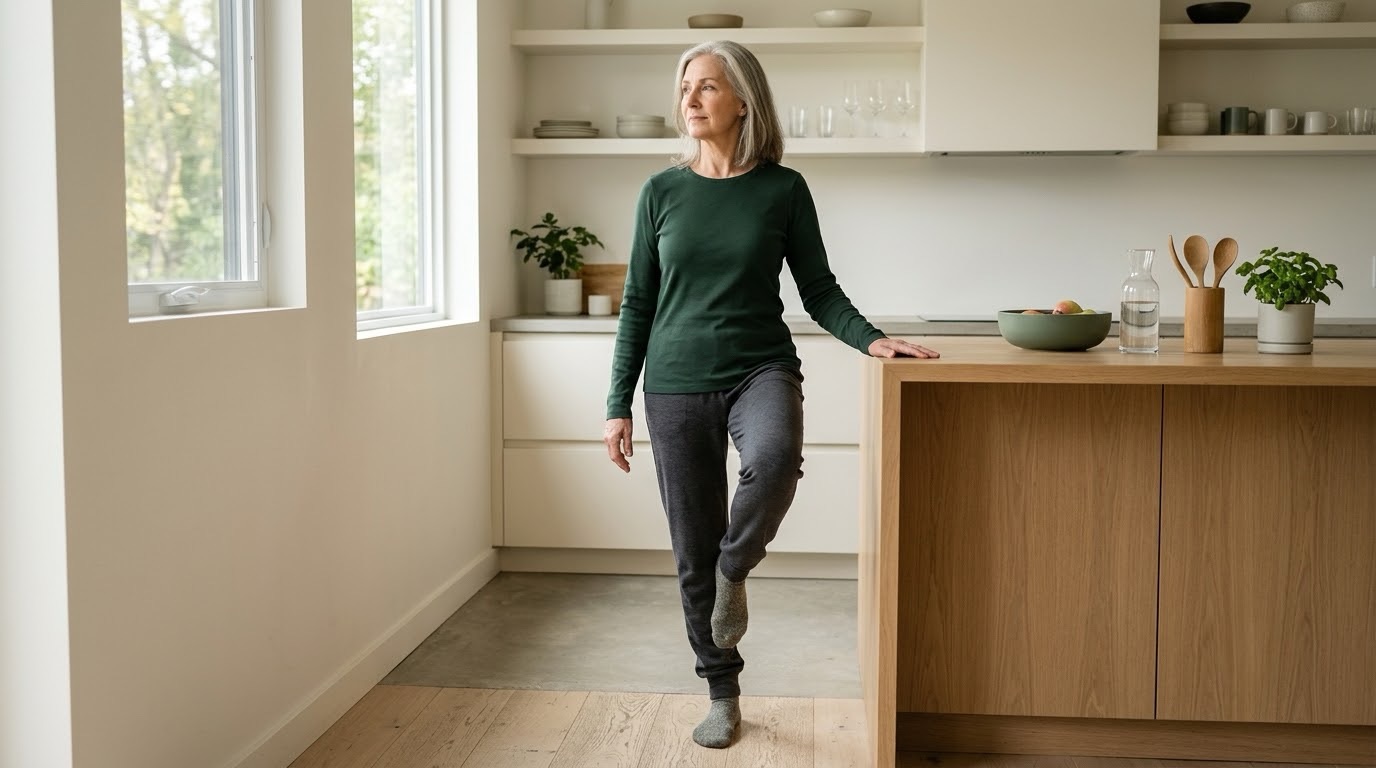
Lift one foot, keeping a hand or fingertips resting on a counter or sturdy chair back for light support — not weight-bearing support, just a safety touchpoint. Hold for up to 30 seconds per side, gradually reducing how much you rely on that touchpoint as it gets easier.
Single-leg, eyes closed
Once you can comfortably hold an unsupported single-leg stance for the full 10 seconds the pillar’s test describes, closing your eyes removes visual input and forces your vestibular and proprioceptive systems to do more of the work on their own. This is a meaningfully harder progression — attempt it near a wall or counter you can catch yourself on, not out in open space.
Dynamic balance challenges
Static holds are the foundation, but real-world balance is mostly dynamic — recovering from a stumble, stepping over an obstacle, catching yourself on uneven ground. Heel-to-toe walking (tandem walking), stepping over a low object, or walking while turning your head side to side all train this more functional layer, and they’re a natural next step once static holds feel solid.
Balance Work for Vertigo, Inner-Ear Issues, or Neurological Conditions
This section matters more here than in most fitness content, given how many NVA readers are managing chronic illness or neurological conditions directly. A few things are worth knowing before starting any balance practice if dizziness, vertigo, or a diagnosed neurological condition is part of your picture.
Not all dizziness responds to the same intervention. Benign Paroxysmal Positional Vertigo (BPPV), one of the most common causes of vertigo, isn’t resolved by general balance exercises at all — it requires specific repositioning maneuvers performed or taught by a trained clinician, and general balance training can be ineffective or uncomfortable if BPPV hasn’t been identified and addressed first. Other vestibular disorders, along with neurological conditions affecting coordination, generally respond well to structured vestibular rehabilitation, but that’s a genuinely individualized program built by a physical or occupational therapist after a proper assessment — not something to reconstruct from a generic list of exercises online.
If you experience dizziness alongside a severe headache, slurred speech, facial drooping, or one-sided weakness, that’s a medical emergency, not a balance-training question — seek immediate care. For ordinary dizziness or vertigo without those red-flag symptoms, the sensible path is a conversation with your doctor before starting any new balance practice, with a referral to a vestibular-trained physical therapist if the underlying cause turns out to need targeted rehabilitation rather than general conditioning.
Structured Options: Tai Chi and Yoga
If self-directed balance drills feel too unstructured, tai chi has the strongest evidence base of any structured practice in this space. A 2023 systematic review and meta-analysis pooling 24 randomized controlled trials found that tai chi reduced fall risk by roughly 24% relative to control groups, decreased the total number of falls, and improved several standard balance measures, including single-leg stance time and gait speed. The effect appears to strengthen with more frequent, sustained practice, and some research suggests Yang-style tai chi outperforms other styles specifically for balance outcomes. It’s worth being honest about the evidence landscape here, though: not every tai chi study has found significant effects, and results vary meaningfully by program duration, frequency, and the specific population studied — this is a genuinely promising intervention, not a guaranteed fix.
Yoga is less extensively studied specifically for fall prevention, but its combination of static holds, controlled weight shifts, and body-awareness training overlaps considerably with the mechanisms that make balance training effective in general, and it’s a reasonable structured alternative for people who prefer it or have access to a local class.
🛒 Shop This Category
A yoga mat, a stability pad, or simple balance-training aids make this easy to practice at home.
The 5-Minute Daily Balance Micro-Routine
Feet-together stance near a counter, 30 seconds. Single-leg stance with light support, 20–30 seconds per side. Single-leg stance unsupported, up to 10 seconds per side (skip this step if it’s not yet stable with support). Ten steps of heel-to-toe tandem walking. That’s the whole thing — done while brushing your teeth, waiting for the kettle, or during a commercial break, most days of the week.
FAQ
How often should I retest my single-leg balance time?
Every 8 to 12 weeks is a reasonable interval — long enough for real neuromuscular adaptation to show up, so you’re tracking genuine progress rather than day-to-day variability.
When should I see a physical therapist instead of practicing on my own?
If you’ve had a fall or near-fall in the past year, if dizziness or vertigo is part of your symptom picture, if you have a diagnosed neurological condition affecting coordination, or if feet-together stance already feels unstable, a PT evaluation is worth the appointment before you build a home practice.
Is it normal for balance to feel worse on some days than others?
Yes. Fatigue, medication timing, blood sugar, inner-ear congestion from a cold, and even stress can all affect balance day to day. A single off day isn’t a meaningful signal — the trend over weeks and months is what matters.
Can balance actually improve, or does it just decline more slowly with training?
Both, depending on your starting point. People who are currently deconditioned often see genuine improvement, not just a slower decline, within weeks of starting consistent practice. For everyone, the realistic goal is a meaningfully slower decline than the untrained trajectory, sustained over years.
Conclusion
Balance gets skipped because it doesn’t announce itself the way strength or cardio fitness does — until the day a curb, a wet floor, or a dark hallway turns it into the only capacity that mattered. The good news is that it responds well to a small, consistent practice, whether that’s a self-directed progression, a tai chi class, or a few minutes folded into your morning routine. If you haven’t tried the single-leg balance test from 5 Simple Tests That Reveal How Resilient Your Body Really Is, that’s the place to find your actual starting point before building the practice described here.
Sources & Further Reading
- Araújo CGS, et al. Successful 10-second one-legged stance performance predicts survival in middle-aged and older individuals. British Journal of Sports Medicine, 2022.
- Balance Begins to Decline as Early as Age 50. UCLA Health.
- Use of the Brief-BESTest Partially Instrumented With Accelerometry to Detect Balance Deterioration in Middle Age. 2024.
- Tai Chi for Fall Prevention and Balance Improvement in Older Adults: A Systematic Review and Meta-Analysis of Randomized Controlled Trials. 2023.
- The Effect of Exercise Intervention on Reducing the Fall Risk in Older Adults: A Meta-Analysis of Randomized Controlled Trials. 2021.
- Vestibular Rehabilitation Therapy (VRT). Vestibular Disorders Association.
- Vestibular Rehabilitation. StatPearls, NIH/NLM.
Disclaimer: This article is provided for educational purposes only and is not intended as medical advice. Always consult a qualified healthcare professional before beginning a new balance training program, particularly if you have a history of falls, dizziness, vertigo, or a neurological condition affecting coordination.