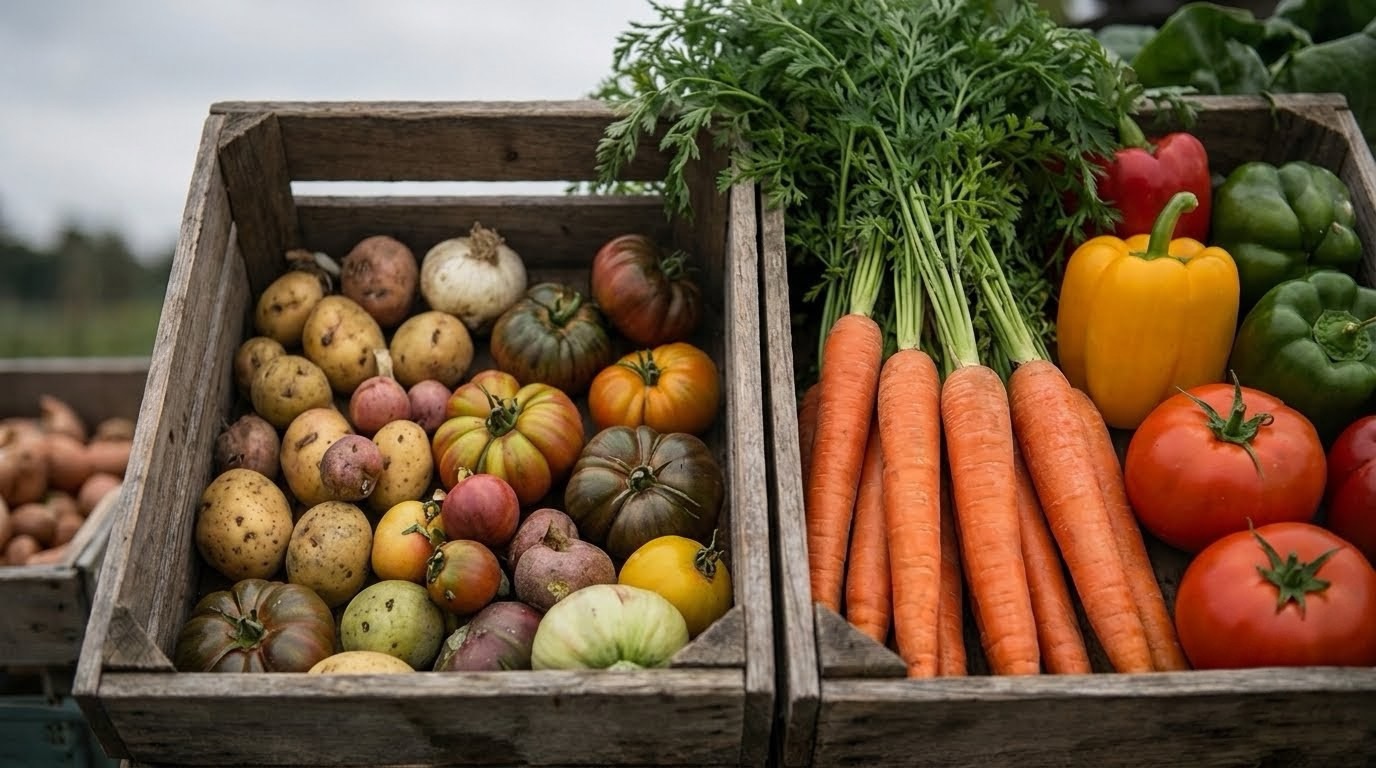
This series started with a simple question — is broccoli man-made? — and it turned out to be the wrong question all along. Part 1 showed that “man-made” isn’t automatically bad. Part 2 showed that “natural” isn’t automatically safe, and that fear sells. Part 3 showed that modern breeding did trade some real things away. This final part brings all three together into something you can actually use standing in a grocery aisle or at a farm stand.
In This Article
From Fear and Nostalgia to Evidence
Three parts in, a pattern should be clear: neither “trust nothing modern” nor “trust everything modern” holds up under scrutiny. The useful question was never whether a food is natural or original. It’s whether it’s nutrient-dense, minimally processed, and supported by good evidence — and that question has a practical, buildable answer.
Building the Plate: The Evidence-Supported Cultivated Powerhouses
Most of the foods with the strongest research behind them for human health are heavily cultivated, not wild — and that’s exactly the point Part 1 opened with. Cruciferous vegetables like broccoli and kale, leafy greens, legumes, berries, and mushrooms consistently show up across the strongest available nutrition research, regardless of how thoroughly humans have reshaped them. Build the base of your plate here first. This is not the tier to be suspicious of.
Where Wild and Heirloom Still Earn a Place
None of this means the wild and heirloom tiers from Part 1’s classification system don’t matter — they earn their place for different reasons than the appeal-to-nature instinct usually gives them credit for. Wild blueberries, dandelion greens, and sea vegetables carry genuinely distinct nutrient profiles worth including, not because they’re “more natural,” but because Part 3 showed some wild relatives really do concentrate compounds modern breeding diluted or bred away. Heirloom tomatoes and heritage grains, sourced through a co-op or farm stand, sit in the same category: not automatically superior, but a genuine, evidence-supported complement to a plate built mostly on modern cultivated staples.
Organic vs. Conventional: Applying Discernment to the Dirty Dozen
This is the question every reader of this series actually faces at the register, and it deserves the same symmetrical scrutiny Part 2 applied to wellness influencers — including when the source is a familiar consumer advocacy group rather than an individual. The Environmental Working Group’s annual “Dirty Dozen” list ranks conventional produce by pesticide residue detection, and it strongly shapes what many health-conscious shoppers choose to buy organic. It deserves credit for raising real awareness — and it deserves the same evidence-based scrutiny this series has applied to everything else.
Here’s the documented gap, in EWG’s own acknowledged words: their methodology does not incorporate a full risk assessment — it ranks the abundance, diversity, and detection of pesticide residues without fully weighing the dose, potency, or EPA-established safety threshold of each one. A 2024 peer-reviewed study applying standard toxicological risk assessment to the list concluded plainly that “the presence of a pesticide residue does not directly translate to meaningful health risk,” and that reporting multiple residue detections without accounting for dose and toxicity can mischaracterize actual exposure risk. EWG updated its methodology in 2025 to add toxicity weighting, a real improvement — but independent researchers note the core gap remains. For context, USDA testing consistently finds that more than 99 percent of sampled conventional produce carries pesticide residues below EPA safety tolerances, and roughly half of Dirty Dozen samples show no detectable residue at all.
Fairness cuts both directions here, which is worth naming directly: the loudest critics of the Dirty Dozen include the Alliance for Food and Farming, an organization funded by the produce industry itself, and some of the research it cites has been industry-funded as well. That doesn’t make the toxicological critique wrong — the dose-response point is a well-established, mainstream principle of toxicology, not an industry talking point — but it’s exactly the kind of funding detail the Incentive Audit asks you to weigh on every side of a debate, not just the side you’re inclined to distrust.
A pesticide residue being detected and a pesticide residue being dangerous are two different claims — and only one of them is what most “clean” and “dirty” produce lists actually measure.
The practical takeaway: buying organic for the handful of crops that consistently test highest in residue, especially for thin-skinned produce eaten frequently, is a reasonable precautionary choice — but it’s a preference grounded in caution, not a finding that conventional produce on that list is unsafe at the levels typically consumed. If cost or access make organic impractical for every item, the evidence doesn’t support skipping conventional produce altogether. The health cost of eating fewer fruits and vegetables is far better established than the health cost of typical pesticide residue exposure.
Using the Decision Compass at the Grocery Store or Farm Stand
NVA’s Decision Compass was built for navigating cancer treatment decisions, but its portable “three questions” version travels well to far smaller decisions too — including the ones you make holding a head of broccoli. First: what does the best available evidence actually suggest about this food or this claim, placed honestly on the Evidence Ladder — established science, emerging research, or anecdote? Second: what incentives might be shaping the recommendation in front of me — a supplement company, an elimination-diet coach, or a consumer advocacy list with its own methodology limits? Third: does this choice actually align with my own values, budget, and health priorities, or am I making it out of fear I haven’t examined?
Applied to a real cart: buy the cultivated, evidence-supported staples without hesitation. Choose organic selectively, where budget allows and residue data genuinely supports it, without treating conventional produce as dangerous. Bring in wild and heirloom foods for what they distinctly offer, not because they’re “purer.” And when a new food fear crosses your feed, run it through the same three questions before you act on it.
Series Recap
- Part 1: The Broccoli Myth — why “man-made” isn’t automatically dangerous, and the four-tier classification system used throughout this series
- Part 2: Nightshades, Oxalates, and Who’s Selling the Alternative — why “natural” isn’t automatically safe, and the Incentive Audit
- Part 3: What We Sacrificed for Modern Agriculture — the real, fair-minded trade-offs of breeding for yield
- Part 4: This post — turning all of it into a practical, evidence-based strategy
FAQ
Is organic worth the extra cost?
For a handful of consistently high-residue crops, it can be a reasonable precautionary choice. It isn’t a food-safety necessity — conventional produce residues typically fall well below EPA safety thresholds.
What’s the single most important factor in choosing produce?
Eating enough fruits and vegetables in the first place. The evidence for that basic habit is far stronger than the evidence for any specific organic-versus-conventional or wild-versus-modern distinction.
How do I apply this if I’m on a tight budget?
Prioritize the cultivated, evidence-supported staples from this article first, buy conventional without guilt, and treat organic and heirloom sourcing as an upgrade to add when budget allows — not a baseline requirement for eating well.
Conclusion
Humans have shaped nearly every fruit and vegetable we eat, through thousands of years of patient, generational attention. The question that actually matters isn’t whether a food is natural or original — it’s whether it remains nutrient-dense, reasonably minimally processed, and supported by real evidence. Sometimes breeding improved a plant dramatically. Sometimes it traded nutrition for sweetness, size, or shelf life. The goal was never to chase wildness. It’s to make informed choices, one honest question at a time.
Farm Fresh To You Reader Referral
If you’re looking to build more of the heirloom and organically grown produce this series discusses into your regular routine, Farm Fresh To You delivers organic produce boxes right to your door. This is my personal referral code, not a commission-based affiliate link — it gets you $15 off your first box.