Two articles sit open in adjacent tabs. One says a specific supplement shrinks tumors and cites “the research.” The other says that same supplement is dangerous quackery and cites “the research.” Both are written with total confidence. Neither one mentions what kind of research it’s actually talking about — whether it’s a study on cells in a lab dish, a clinical trial in actual patients, or something in between. To someone trying to make a real decision, the two tabs look identical: equally certain, equally cited, equally impossible to tell apart.
This isn’t a failure of intelligence. It’s what happens when a mind that’s already running on stress hormones at 2 a.m. is asked to sort real evidence from confident noise, using a skill almost nobody was ever taught. The good news is that the skill is learnable, and it doesn’t require a science degree — it requires a framework simple enough to use in the middle of the night and honest enough to hold up under scrutiny.
In This Article
Why Smart People Get Fooled
Nobel laureate Daniel Kahneman spent much of his career mapping two different modes the human mind uses to think. He called them System 1 and System 2. System 1 is fast, automatic, and intuitive — the mode that reads a headline and reacts before any conscious reasoning happens. System 2 is slow, effortful, and deliberate — the mode capable of actually weighing evidence, but one the brain avoids using whenever it can get away with a quicker answer.
Under normal circumstances, System 1 does a reasonably good job — most daily decisions don’t require careful analysis. But a serious diagnosis is precisely the kind of high-stakes, emotionally loaded situation where System 1’s fast, confident judgments are least trustworthy and most likely to be mistaken for careful thinking. Intelligence doesn’t fix this. A brilliant, highly educated person under acute stress is exactly as vulnerable to System 1’s shortcuts as anyone else — arguably more so, since confidence in one’s own reasoning can make the shortcut harder to notice.
The Availability Heuristic
One of the most well-documented System 1 shortcuts is the availability heuristic: the tendency to judge how likely or true something is by how easily an example comes to mind, first described by Amos Tversky and Daniel Kahneman in 1973. A survivor’s video — her face, her voice, her specific story of recovery — comes to mind instantly and vividly. A clinical trial’s confidence interval does not. That difference in vividness has nothing to do with which one is actually more representative of what happens to most patients, but it strongly predicts which one feels more true.
This is worth sitting with, because it isn’t an argument against survivor stories. A survivor’s account can be completely honest and still tell you almost nothing about what will happen to the next person who tries the same thing. The story and the statistic are answering two different questions, and only one of them is built to answer “how likely is this to work for me.”
Confirmation Bias and Authority Bias
Two more shortcuts compound the problem. Confirmation bias is the tendency to notice and remember information that supports what you already hope is true, while skimming past what complicates it — and fear makes people search for hope, not search neutrally. Authority bias is the tendency to extend more credibility to a confident, credentialed-sounding voice than the evidence behind that voice actually earns. Under stress, both operate more strongly, not less. A calm, certain tone gets mistaken for expertise; a source that says what you’re hoping to hear gets less scrutiny than one that doesn’t.
A Ladder, Not a Flood
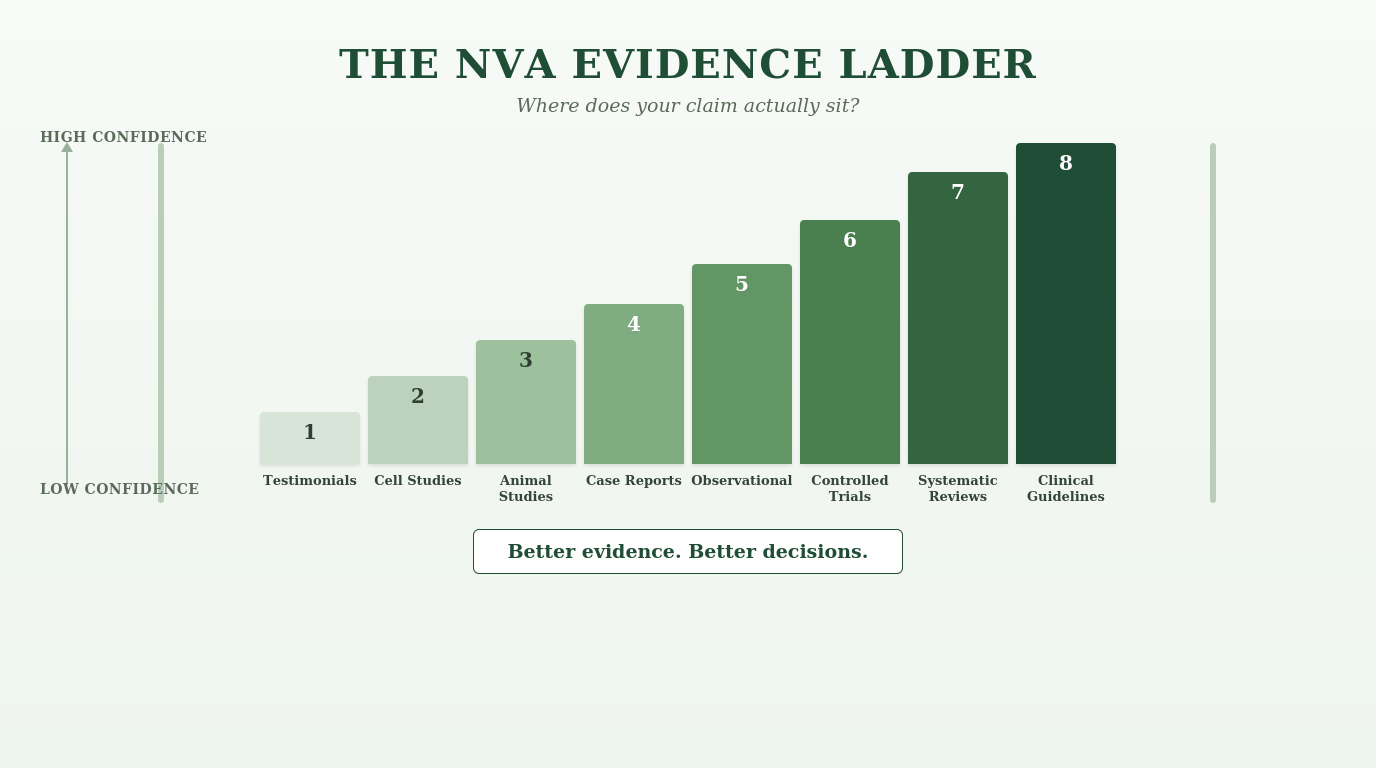
The corrective isn’t to distrust everything, and it isn’t to trust whatever sounds most confident. It’s to place each piece of information on a ladder according to how much certainty it can actually support — a version of the evidence hierarchies long used in evidence-based medicine, adapted for someone evaluating a claim from a phone at midnight rather than a researcher in a library.
| Level | What It Is | What It Can (and Can’t) Tell You |
|---|---|---|
| 1 | Personal testimonial | Tells you something is possible. Can’t tell you how likely, or for whom. |
| 2 | Cell study (in vitro) | Shows a mechanism might exist in a dish. A living body is a very different environment. |
| 3 | Animal study | Adds real biology — metabolism, immune response. Still frequently fails to translate to humans. |
| 4 | Case report / case series | Real human outcomes, but too small and uncontrolled to generalize. |
| 5 | Observational study | Looks at real populations. Shows association, not proof of cause. |
| 6 | Randomized controlled trial | The clearest evidence that an intervention does what it claims — though funding and design can still bias results. |
| 7 | Systematic review / meta-analysis | Synthesizes many trials into one picture. Among the most reliable evidence available. |
| 8 | Clinical practice guideline | The distilled expert consensus — not infallible, but the most rigorously filtered synthesis there is. |
Nothing on this ladder is worthless — a compelling case report is worth reading, and a promising cell study deserves attention. The point isn’t to dismiss the lower rungs. It’s to weight each one honestly instead of letting confidence and vividness do the weighting for you.
Questions Worth Bringing to Any Claim
These apply equally to a supplement company’s white paper and a hospital’s own marketing material — neither side gets a free pass:
- Where does this sit on the ladder — and does the claim’s confidence match that level, or overstate it?
- Is this a new, unreplicated finding, or has it been confirmed by independent research?
- Who conducted or funded this, and what do they stand to gain if I believe it?
- What do the study’s own limitations say, not just the headline built from it?
- What would it cost me if this claim turns out to be wrong?
Frequently Asked Questions
Does this mean I shouldn’t trust survivor stories?
No — it means holding them for what they are. A survivor’s story can be true, moving, and genuinely worth hearing, while still being Level 1 evidence: it tells you something was possible for one person, not how likely it is to work for you.
Does a low rung on the ladder mean a treatment doesn’t work?
Not necessarily. It means the evidence hasn’t yet reached a level that supports strong confidence either way. Many treatments now considered standard started as a cell study or a handful of case reports — the ladder describes certainty, not final verdicts.
Does this apply to conventional medicine too, or just alternative claims?
Both, without exception. A pharmaceutical company’s press release and a wellness influencer’s video can occupy the exact same rung on the ladder if the underlying evidence is equally thin. The ladder doesn’t care about the source’s reputation — only about what kind of evidence it’s actually standing on. A currently unfolding example worth applying this to directly is the viral claim that anti-parasitic drugs treat cancer — real mechanism, mixed evidence tiers depending on the specific drug, and a useful test case for the whole framework.
The goal was never to make you suspicious of everything. It was to give you one honest question to return to, whenever a confident claim arrives at exactly the moment you’re least equipped to evaluate it: where does this actually sit on the ladder, and does the confidence behind it match?
Read the Full Framework
This post covers one chapter’s core idea. The complete framework — the full Evidence Ladder, the Incentive Audit, and the Decision Compass that ties evidence to your actual values — is in Navigating Cancer Between Hope and Hype.
Sources & Further Reading
- Daniel Kahneman, 2002 Nobel Prize in Economic Sciences — background on the System 1 / System 2 research from Thinking, Fast and Slow.
- Tversky, A., & Kahneman, D. (1973). “Availability: A heuristic for judging frequency and probability.” Cognitive Psychology, 5(2), 207–232.
- “Understanding the Levels of Evidence in Medical Research.” PMC, National Institutes of Health.
Disclaimer: This article is for educational purposes only and is not intended as medical advice, and it is not intended to tell any reader which specific treatment to choose. Always work with a qualified healthcare professional when evaluating treatment decisions. Natural Vitality Advocate encourages readers to pursue natural and lifestyle-based strategies alongside, not in place of, appropriate medical care.