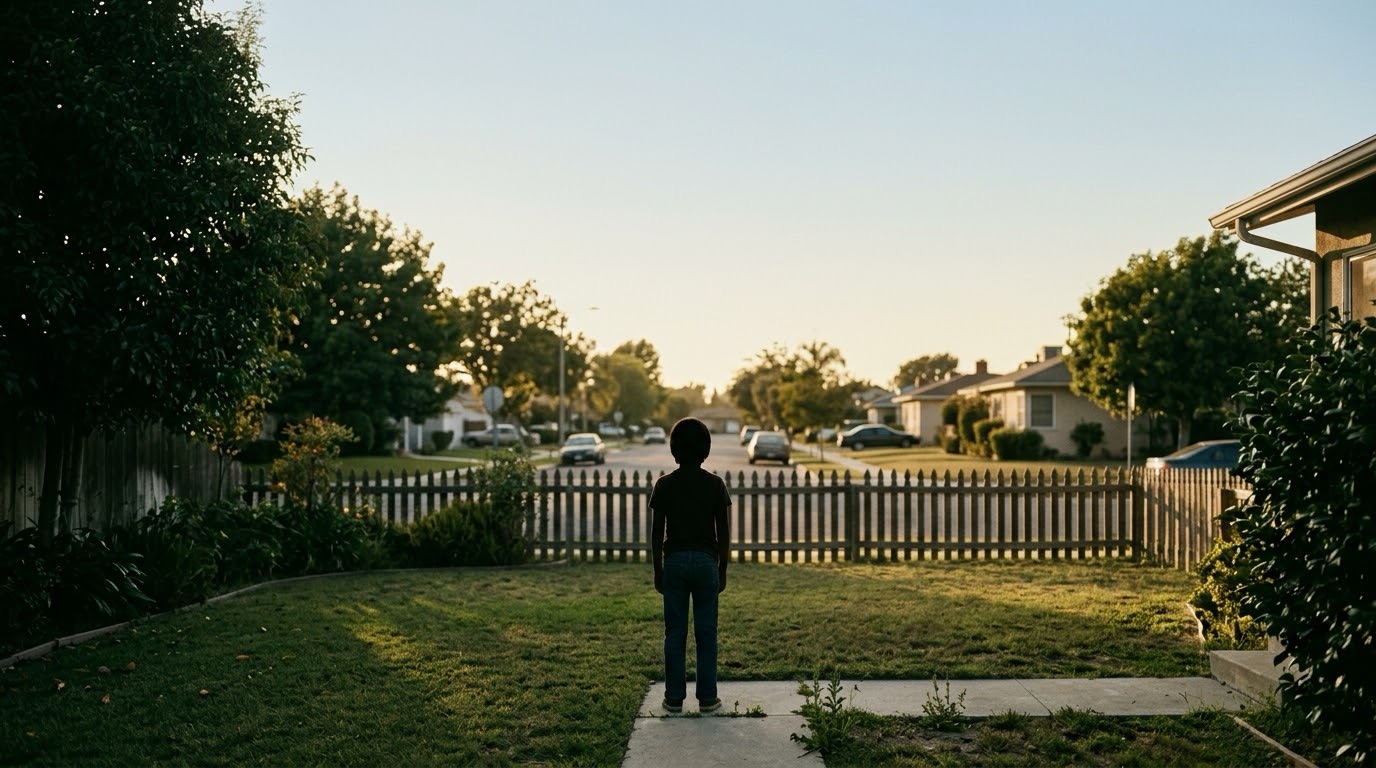
There’s a particular kind of loneliness that doesn’t announce itself. It doesn’t come from anything anyone did or said. It doesn’t have an incident attached to it that you could point to later and say, that’s when it started. It’s quieter than that — a low, steady sense of being slightly out of step with everyone around you, present in ordinary moments that look, from the outside, completely unremarkable.
I grew up in Southern California in a house that looked like every other house on the street. Warm evenings. Ordinary rhythms. A childhood that had every visible marker of being fine. And for a long time, that’s exactly what I thought it was — fine, unremarkable, the same as everyone else’s. What I didn’t have yet was any language for the parts of it that didn’t quite fit.
What It’s Like to Be Subtly Outside
There’s a specific texture to this kind of childhood experience that’s hard to describe to someone who hasn’t lived it, and easy to recognize instantly for someone who has. It isn’t dramatic. Nobody excludes you outright. You’re not friendless or visibly struggling in a way that draws concern. You’re just a half-step behind or beside whatever rhythm everyone else seems to move through without effort — a little more work required to keep pace with a conversation, a little more energy spent managing something you couldn’t name, a little more exhaustion at the end of an ordinary day than the day itself seemed to justify.
You learn to perform normal. Not out of deception, but out of necessity — because there’s no diagnosis yet to explain why things take more out of you than they seem to take out of anyone else, and without a diagnosis, the only available explanation is some quiet, private sense that the deficiency must be your own. Not enough effort. Not enough discipline. Not enough of whatever everyone else apparently has that makes this look easy.
That belief settles in early, and it settles in deep, precisely because it’s never actually said out loud by anyone. It’s not an accusation you can defend yourself against. It’s just a private, background hum — a sense that everyone else got a manual you never received, and that the gap between you and them is a character flaw rather than a neurological one waiting years to be identified.
For Anyone Who Recognizes This
If any of this sounds familiar — if you spent years of your own childhood sensing something was different before anyone had a name for it, medical or otherwise — I want to say plainly that you weren’t imagining it, and you weren’t simply failing to try hard enough. Kids are remarkably perceptive about their own internal experience long before they have the vocabulary or the outside information to make sense of what they’re perceiving. The sense that something is quietly uneven is frequently accurate, even when nobody around you, including the adults responsible for noticing, has yet connected it to anything.
This isn’t a call to diagnose your own childhood retroactively, or to search backward for an explanation that fits neatly onto every hard year. Some things really were just ordinary childhood difficulty. But some things weren’t, and the ones that weren’t deserve to be taken seriously rather than quietly absorbed as evidence of some personal shortcoming. Naming something later doesn’t undo the years spent not knowing. It also doesn’t need to. What it can do is finally let you stop blaming yourself for something that was never a character issue in the first place.
Closing
I didn’t know, as a kid in Southern California, that any of what I was quietly carrying had a name waiting for it. I just thought this was who I was — a little behind, a little more tired than the moment called for, trying to keep pace with a rhythm that never quite matched mine. It would be years before any of that resolved into an actual explanation. Looking back, I can see the shape of it clearly now. At the time, it was just what ordinary felt like.
The explanation, when it finally arrived, brought its own kind of upheaval. What a Diagnosis Actually Does picks up where this leaves off — what it’s like when the word you’d been missing finally arrives.
This post touches one thread of a much longer story. Still Walking tells the fuller account — the childhood, the years before diagnosis, and everything that came after.
Read the Full Story
This post touches one theme. The full childhood story is in “Still Walking.”
Disclaimer: This post reflects personal experience and perspective. It is not intended as medical or psychological advice. If aspects of childhood or family history are affecting your wellbeing today, a licensed therapist or counselor can offer support this post is not equipped to provide.