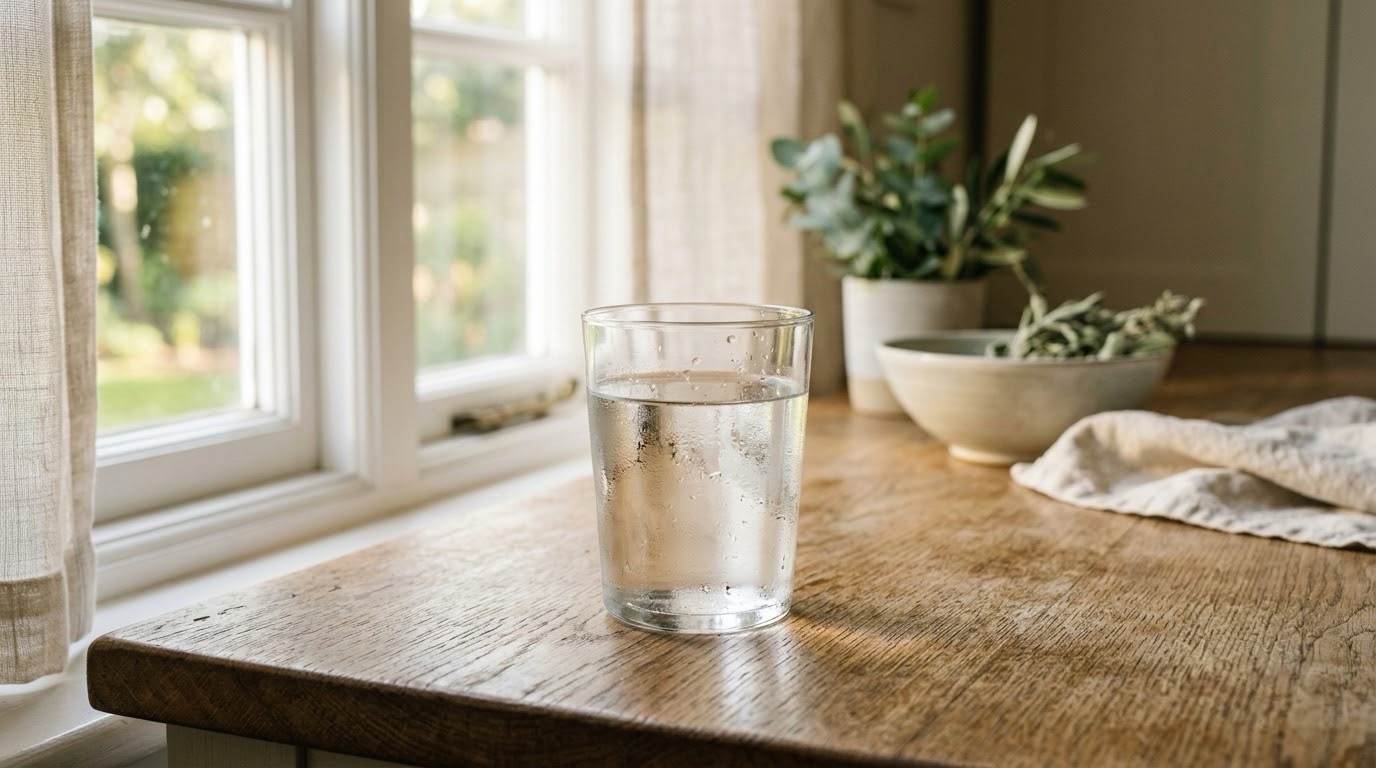
For most of my life I didn’t think about water at all. It was just there — something that came out of a tap or a filter, consumed without a second thought because it seemed like the most neutral input imaginable. Whatever else I was questioning about my diet or my environment, water simply wasn’t part of the conversation. It was background. It was assumed.
That assumption lasted longer than most of my other unexamined ones, partly because water feels so fundamental that questioning it seems excessive, and partly because any effect it might be having was slow and diffuse enough that I couldn’t trace a clear line from it to anything specific. That turned out to be exactly the reason it was worth questioning.
Meeting a Legal Standard Isn’t the Same as No Consequence
Municipal water systems across most of the developed world deliver water that meets legal safety standards. That’s a real and meaningful baseline — not something to dismiss. But meeting a legal threshold isn’t automatically the same as being without consequence over a lifetime of consumption. The compounds present in treated water — chlorine byproducts, fluoride, trace pharmaceutical residues that pass through treatment systems, agricultural runoff that varies by region and season — are present in amounts considered acceptable at any single exposure. What those amounts add up to across years of daily drinking, cooking, and bathing is a genuinely different calculation, and it’s not one that single-exposure safety standards were designed to answer.
It’s worth being honest that the science here is uneven rather than settled across the board. A widely cited 2014 review in The Lancet Neurology catalogued a growing list of industrial chemicals with documented links to developmental neurotoxicity — lead, methylmercury, arsenic, and several others with strong, well-replicated evidence behind them. The same review also flagged fluoride as a possible concern, a claim that drew genuine pushback from other researchers in the scientific literature, who pointed to studies the original review hadn’t addressed and to concerns about how the underlying data was interpreted. That’s not a reason to dismiss the broader concern about cumulative water exposures — it’s a reason to hold any single compound’s specific risk with real humility rather than certainty in either direction.
Why Daily, Diffuse Exposures Are Easy to Miss
The difficulty with this kind of exposure is that its effects, if they exist, rarely announce themselves clearly. There’s no acute moment, no obvious incident connecting a specific input to a specific outcome. What tends to happen instead is a slow accumulation that contributes to a general state — a level of burden on the body’s filtration and regulatory systems — without producing a single visible event that makes the cause legible. Humans are reasonably good at connecting a dramatic input to a dramatic outcome. We’re much worse at connecting something ordinary and constant to something gradual and diffuse. The distance between cause and effect, stretched across months or years of repetition, makes the relationship nearly invisible — and because it’s nearly invisible, it stops getting looked for.
What Feels Neutral Isn’t Always Harmless
The research on specific water compounds is genuinely uneven — strong in some areas, contested in others, and largely absent in the area that arguably matters most: cumulative exposure to multiple compounds simultaneously, over long periods of ordinary life. What’s clear enough to act on, even without a single definitive study attached to it, is the underlying principle: the body’s regulatory systems have a finite capacity, and reducing the burden on those systems where reasonably possible is worth doing, independent of having a precise number attached to the return.
This logic doesn’t stop at water. It applies to anything so constant and so ordinary that it escapes evaluation entirely — the air in a space inhabited every day, the materials in products used without a second thought. Familiarity creates an assumption of safety that a given substance may not have actually earned, and the more constant the exposure, the more that assumption is worth examining honestly.
Closing
None of this calls for eliminating everything — that standard isn’t achievable, and pursuing it produces its own kind of burden. What it calls for is understanding a little more than before, and reducing what can reasonably be reduced. That’s a workable standard. It doesn’t require perfection. It requires honesty about what’s been going unexamined, and a willingness to look at the inputs that feel too ordinary to ever question. The most consistent exposures are often the ones most worth a second look — precisely because their consistency is what makes them matter. Water is one piece of a larger picture; The Healing Home lays out the fuller framework for thinking through environmental exposure generally, without tipping into fear.
Read the Full Story
This post touches one chapter. The full argument is in You Do You.
Sources & Further Reading
Disclaimer: This article reflects personal experience and perspective and is not intended as medical advice. Natural Vitality Advocate encourages readers to pursue natural and lifestyle-based strategies alongside, not in place of, appropriate professional guidance.