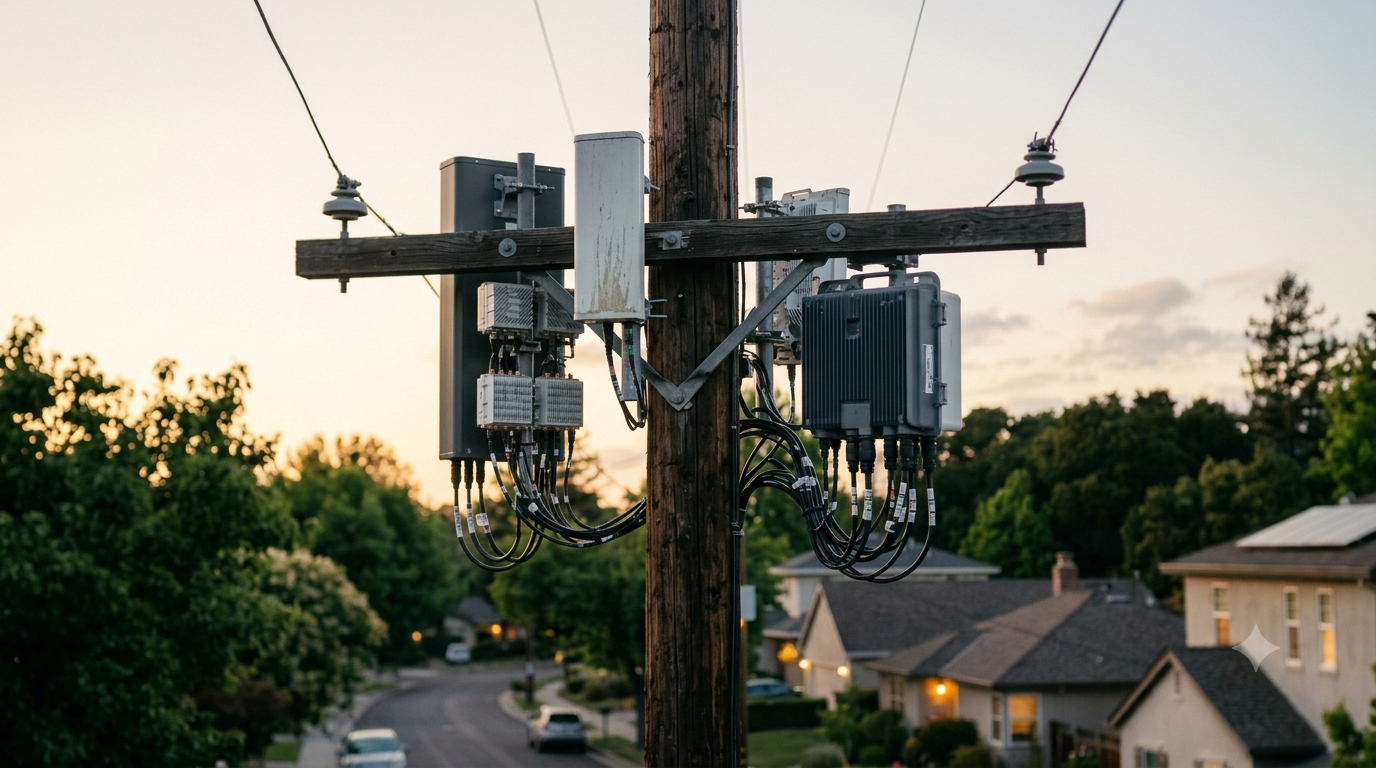
A truck pulls up. A gray metal box goes on the pole at the edge of your yard, or the edge of your kid’s school. Nobody asked you first. And within a week, someone has sent you a video with 25,000 shares telling you exactly what that box is doing to your children.
That scenario is playing out in neighborhoods across the country, and it’s worth taking seriously — not because the viral version of the story is accurate, but because the underlying question isn’t crazy. Does radiofrequency exposure from cell towers, phones, and wireless devices carry real health risk? People are right to want an honest answer instead of a reassuring one or a frightening one.
The trouble is that the conversation around 5G and EMF has split into two camps that both overstate their case. One side treats any concern as tinfoil-hat thinking, full stop. The other treats every gray utility box as a slow-motion public health emergency. Neither posture actually requires you to look at the evidence. This piece does — using only regulatory and peer-reviewed sources, walking through a real case study that got misrepresented by almost everyone who shared it, and building a framework you can reuse the next time a claim like this shows up in your feed.
In This Article
What’s Actually Documented
Start with what isn’t in dispute. Radiofrequency (RF) energy from phones, Wi-Fi routers, and cell towers is non-ionizing radiation — meaning it doesn’t carry enough energy per photon to break chemical bonds or strip electrons from atoms the way X-rays or gamma radiation can. That distinction matters enormously. Ionizing radiation causes damage by a well-understood mechanism: it can directly damage DNA. Non-ionizing radiation, at the power levels involved in consumer wireless technology, cannot do that by the same mechanism. This isn’t a contested claim; it’s basic physics.
The one well-established biological effect of RF energy at high enough intensity is heating — the same principle a microwave oven uses, just at vastly higher output than any phone, router, or tower. Regulatory exposure limits in the United States are set by the FCC and built around keeping absorbed energy far below the threshold where measurable tissue heating occurs, with a substantial safety margin layered on top. Cell towers, including the small-cell equipment used for 5G, typically operate at a fraction of these already-conservative limits, and exposure drops off sharply with distance — standing near the base of a tower exposes you to far less RF energy than the main beam pattern above it, and ordinary distance from any tower keeps exposure well under the ceiling.
None of that means the conversation stops there. “It hasn’t been shown to cause thermal harm at legal exposure levels” is a narrower claim than “it has been proven completely safe in every respect,” and the honest version of this article has to hold both of those sentences at once.
Where the Legitimate Disagreement Actually Lives
This is the part most content on this topic skips, in one direction or the other. There are two real findings in the research record that deserve a fair hearing rather than a dismissal.
In 2011, the International Agency for Research on Cancer (IARC), the cancer research arm of the World Health Organization, classified radiofrequency electromagnetic fields as Group 2B: “possibly carcinogenic to humans.” That sounds alarming until you see what else lives in Group 2B — roughly 250 other agents, including pickled vegetables and aloe vera extract. The classification reflects the strength of the evidence, not the size of the risk, and it was driven mainly by a couple of case-control studies suggesting a possible association between heavy long-term mobile phone use and specific tumor types (glioma and acoustic neuroma). IARC itself has flagged RF-EMF as a high priority for re-evaluation given the volume of newer research, and that reassessment has been underway for several years without a published update as of this writing — worth checking IARC’s own tracking page if you’re reading this well after publication, since a classification review is exactly the kind of status that can change.
Separately, in 2018 the National Toxicology Program (NTP) — part of the National Institutes of Health — published results from a roughly $25 million, decade-long study exposing rats and mice to RF radiation for two years. The finding was real and shouldn’t be waved away: “clear evidence” of malignant heart schwannomas in male rats, plus some evidence of brain tumors. But the study design matters as much as the result. The animals received whole-body RF exposure, continuously, for most of their two-year lives, at intensities at or above the FCC’s human exposure limit — nothing close to how a person actually uses a phone or lives near a tower. The NIEHS fact sheet on the study is explicit that these results shouldn’t be directly extrapolated to typical human cell phone exposure, and the effect was seen only in male rats, not female rats or mice of either sex — a pattern that raises real questions about mechanism rather than settling them.
The honest summary: there is a documented, unresolved research question about long-term, high-intensity RF exposure and certain tumor types in animal models. There is not documented evidence that RF exposure at the levels people actually encounter from towers, phones, or wearables causes those outcomes in humans. Those are two different sentences, and a lot of viral content collapses them into one.
A Framework for Evaluating Claims Like This
Rather than trying to memorize the state of the RF research forever, it’s more useful to have a small set of questions you bring to any claim in this space — EMF or otherwise.
Who is making the claim, and what do they have to gain? A regulatory body publishing exposure standards and a company selling EMF-blocking phone cases have very different incentive structures. That doesn’t make the regulator automatically right or the seller automatically wrong — but it tells you where to look harder.
What would falsify this claim? “This tower is disrupting the neighborhood’s bioelectric field” isn’t a testable statement as written. “RF exposure at this distance measures X, compared to a federal limit of Y” is. If a claim can’t be tested, it can’t really be evaluated — it can only be believed or not.
Does the timeline actually match the technology? A huge share of viral EMF content simply gets the facts of the story wrong before it gets to the science. That’s exactly what happened in Ripon, California.
What track record does the source have? A regulatory body that has revised its guidance before, in either direction, in response to new evidence is behaving the way a credible institution should. A source that has never once said “we were wrong” or “the evidence has changed” is worth a second look, regardless of which direction its claims lean.
The Ripon, California Case Study
In 2019, a video with the headline “5G tower next to school removed after 4 young elementary students develop cancer” spread to more than 25,000 shares on Facebook. It centered on Weston Elementary School in Ripon, where four children and three teachers had been diagnosed with cancer over a period of years — a genuinely painful cluster that parents were right to want answered.
Here’s what the independent fact-checking organization Full Fact found when it examined the claim: the tower was installed by Sprint in 2009 — nearly a decade before 5G existed anywhere in the United States. It wasn’t a 5G tower. It never had been. That single factual error was baked into the headline that 25,000 people shared.
The RF exposure question was also tested, more than once. According to CBS News reporting, the school district’s engineers measured the tower’s output at levels meeting government and industry standards, and Sprint’s own testing put it roughly 100 times below the federal exposure limit. Parents, understandably unsatisfied, hired an independent investigator who measured higher readings — but even those elevated readings still fell within government safety limits. Sprint ultimately shut the tower down and agreed to relocate it anyway, in response to community pressure rather than a safety finding.
That should have been where the story ended, but it’s actually where it got more interesting. Parents and journalists kept digging, and CBS Sacramento’s investigation found something the tower theory had distracted from: the school’s drinking fountain tested positive for trichloroethylene (TCE), a known carcinogen, at 0.56 micrograms per liter — about a third of California’s Public Health Goal for the chemical, though parents weren’t notified of the results at the time they were collected. The contamination traced back to a Nestlé coffee-decaffeination plant that had used TCE in Ripon from 1957 to 1970, discharging it into the city’s sewer system and groundwater. Separate soil vapor testing later turned up a related chemical, PCE, near the school as well. One city drinking-water well was eventually found with TCE levels reaching 90 percent of the EPA’s maximum allowed limit and was shut down. No study has established a confirmed causal link between the contamination and the specific cancer cases at the school — that’s a genuinely open question, and it should stay open rather than get forced into a tidy conclusion in either direction.
What actually happened at Ripon is a case study in exactly the discernment framework above. The visible, novel-sounding threat — a cell tower, wrongly labeled as the newest and scariest generation of the technology — drew nearly all of the public attention and the viral outrage. The invisible, decades-old, well-documented contaminant sitting in the town’s water and soil got far less scrutiny for years, even though it’s the substance with an actual, well-established mechanism for causing cancer at sufficient exposure. That’s not a story about towers being safe or dangerous. It’s a story about which risks get attention because they’re easy to picture, and which risks get missed because they aren’t.
Practical Steps That Match the Actual Evidence
None of this means shrugging off every question about wireless exposure. It means calibrating your response to what the evidence actually supports.
- Don’t sleep with your phone against your head or under your pillow. This costs nothing, and it addresses the one exposure pathway (close, sustained, head-adjacent contact) that shows up in the research that exists.
- Use speaker or headphones for long calls rather than holding the phone to your ear, for the same reason.
- Keep a measured posture with children’s device use — not out of proven danger, but because their nervous systems are still developing and the long-term data on lifetime wireless exposure starting in childhood simply doesn’t exist yet. That’s a real gap, not a confirmed risk, and it’s reasonable to let it inform screen-time and device decisions.
- Skip the EMF-blocking products — shielding fabric, grounding mats marketed for this purpose, phone radiation stickers — unless you’ve seen independent testing data, not manufacturer claims. The FTC took enforcement action against radiation-blocking patch sellers back in 2003 after independent testing found no measurable protective effect; the products in that category have simply been repackaged since.
- If a tower or small-cell installation goes up near you and you want real numbers rather than reassurance or alarm, RF exposure at a given location can be independently measured. That’s a better use of energy than sharing a video before checking when it was installed.
- If you or a family member has a pacemaker or implantable defibrillator, this is the one place where device interference is well-established, not speculative — and it has nothing to do with the cancer question above. The FDA recommends keeping phones and smartwatches at least six inches from the implant, avoiding a shirt or jacket pocket that sits over the device, and holding a phone to the ear opposite the implant when possible. This is a real, documented electromagnetic interaction, and it’s a good example of a genuine caution worth taking seriously precisely because it’s specific and testable — unlike the vaguer claims this article is mostly pushing back on.
Common Misconceptions Worth Naming Directly
“5G is a completely new, untested kind of radiation.” The vast majority of 5G deployment in the U.S. uses low- and mid-band frequencies that sit in the same general range as 4G LTE, at comparable power. The frequencies where there’s a genuine gap in research — millimeter-wave, above 6 GHz — are used for a small slice of dense urban small-cell deployments, not the 5G most people actually connect to.
“COVID-19 was caused or spread by 5G networks.” This claim circulated widely in 2020 and has no basis in virology, physics, or epidemiology; a virus and a radio wave are not the same category of thing, and there is no mechanism by which one produces the other.
“If regulatory agencies say it’s safe, that settles it forever.” Exposure standards get revisited as research accumulates, and it’s fair to ask when a given guideline was last updated and what evidence it’s based on. Institutional confidence isn’t the same as institutional infallibility — but neither is it evidence of a cover-up. Ask who funds the research, what the track record looks like, and what would change the agency’s position, rather than assuming either perfect trust or hidden motive.
FAQ
Is it safe to live near a cell tower?
Based on current evidence, RF exposure from towers at typical residential distances falls well under federal safety limits, which themselves carry a substantial safety margin. The open research questions in this space concern long-term, high-intensity exposure patterns that don’t match typical residential proximity to a tower.
Should I be more cautious with my kids’ phone use because of EMF?
Reasonable caution around total screen time and device habits is worth having for several reasons — sleep, attention, and posture among them — and the incomplete long-term RF data for lifetime childhood exposure is a fair additional reason for moderation, not panic.
What about 5G specifically — is it different from earlier generations?
Most 5G in current use operates in frequency ranges similar to 4G LTE. The higher millimeter-wave frequencies used in some urban deployments are less studied, which is a legitimate research gap worth tracking rather than a confirmed hazard.
How do I evaluate the next viral EMF story I see?
Check the basic facts first — installation date, technology type, actual measured exposure — before evaluating the health claim built on top of them. In Ripon, the factual error (calling a 2009 tower “5G”) undid the entire premise before the science even entered the conversation.
Where This Leaves You
The people fighting to get that tower removed at Weston Elementary weren’t foolish, and they weren’t wrong to be scared. They had watched their children get sick, in a cluster that had no obvious explanation, and they did the only thing that felt like taking action. That instinct deserves respect even where the specific conclusion didn’t hold up. The problem was never that they asked questions. It’s that the loudest, most shareable answer arrived faster than the accurate one — and by the time the accurate one showed up, in the form of unglamorous water-testing data, far fewer people were still paying attention.
That’s the pattern worth carrying forward, more than any specific fact about RF exposure limits. The visible, novel, easy-to-picture threat will usually get more attention than the slow, invisible, well-documented one. Discernment means resisting that pull long enough to ask what’s actually been measured, who measured it, and what would have to be true for the claim to be wrong. That’s not a formula for certainty. It’s a formula for making decisions you can stand behind once the full picture comes in.
For a related look at how this same pattern plays out with a device most people wear on their wrist every day, see Does Your Apple Watch Harm You? Cutting Through the EMF Influencer Claims.
Want a repeatable framework for claims like this?
You Do You is my book on critical thinking — how to evaluate evidence, spot incentives, and make informed decisions in a world full of noise. Get a free overview.
Sources & Further Reading
- International Agency for Research on Cancer. IARC Classifies Radiofrequency Electromagnetic Fields as Possibly Carcinogenic to Humans. Press Release No. 208, 2011.
- National Institute of Environmental Health Sciences. NTP Cell Phone Radiofrequency Radiation Studies. NIH/NIEHS.
- National Toxicology Program. Cell Phone Radio Frequency Radiation Studies Fact Sheet. NTP, January 2024.
- Full Fact. A Mobile Phone Mast Was Relocated Due to Local Concerns About School Cancer Cases.
- CBS News Sacramento. After Several Childhood Cancer Cases at One School, Parents Question Radiation From Cell Tower.
- CBS News Sacramento. Cancer-Causing Chemical Found in School Drinking Fountain, Parents Weren’t Notified.
- CBS News Sacramento. Cancer-Causing Chemical Found in Ripon Soil Vapor Not the One Parents Expected.
- Federal Communications Commission. Human Exposure to Radio Frequency Fields. FCC Consumer Guide.
- Federal Trade Commission. Marketers of Cell Phone Radiation Protection Patches Settle FTC Charges. FTC Press Release, 2003.
- U.S. Food and Drug Administration. Potential Cell Phone Interference with Pacemakers and Other Medical Devices. FDA.
Disclaimer
This content is for informational purposes only and is not a substitute for professional medical advice, diagnosis, or treatment. Always consult a qualified healthcare professional before making any changes to your health regimen. David Julian, Natural Vitality Advocate, is not a licensed medical professional. Views expressed are personal and based on lived experience — they do not guarantee specific outcomes. David Julian is not affiliated with Natural Vitality or NaturalVitality.com.