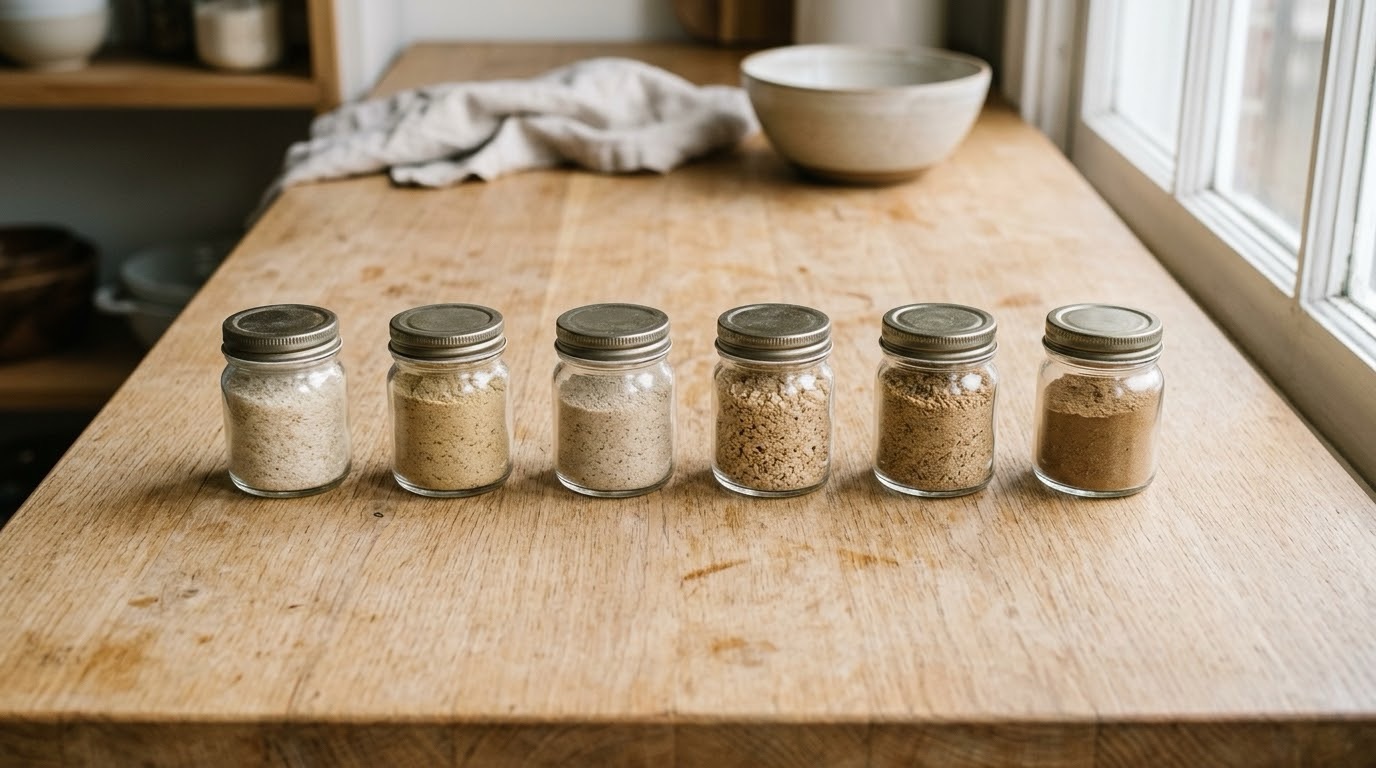
Walk into any health food store and the fiber aisle looks like one big category — inulin, psyllium, acacia, guar gum, all sitting on the same shelf with roughly the same marketing language about “gut support.” They are not the same thing, and treating them as interchangeable means you might reach for the wrong one for what you’re actually trying to solve. Some of what’s on that shelf you could just as easily get from food. Some of it genuinely can’t be replicated through diet alone. Here’s how to think through the difference.
In This Article
- Not All Fiber Does the Same Job
- Inulin: Real Food Sources vs. a Studied Dose
- PHGG: A Supplement-Category Fiber With Strong Evidence
- Acacia Fiber: Gentle and Slow-Fermenting
- The Food-First Group: Resistant Starch, Pectin, and Beta-Glucans
- Psyllium Husk: A Different Mechanism Entirely
- A General Framework for Timing Fiber Around Medications
- Building a Realistic Routine
- Prebiotic Fiber vs. Probiotics: Which Is the Better Value?
- FAQ
- Conclusion
Not All Fiber Does the Same Job
The core distinction worth understanding is that fiber falls into two functionally different categories. Fermentable, prebiotic fibers — inulin, PHGG, acacia — feed the bacteria living in your colon, and the byproducts of that fermentation (short-chain fatty acids like butyrate) are where most of the interesting health effects come from. That mechanism is covered in depth in the pillar piece on the gut-muscle-pain connection, if you want the full picture. Bulk-forming, gel-forming fibers like psyllium work through an entirely different, mostly mechanical process. Neither category is “better” — they solve different problems, and knowing which one you’re actually trying to solve is the useful first step.
Inulin: Real Food Sources vs. a Studied Dose
Inulin is genuinely food-available — chicory root, Jerusalem artichokes, garlic, onions, leeks, asparagus, and bananas all contain it naturally. The honest complication is fermentation speed: inulin ferments relatively quickly, which is part of why it’s an effective prebiotic, but it’s also why it can cause noticeable gas or bloating, especially for anyone with SIBO or a sensitivity to fermentable carbohydrates. Starting with a small amount — a gram or two — and increasing gradually over several weeks is a far more comfortable approach than jumping straight to a full dose. As covered in the companion piece on the INSPIRE trial, hitting a specific, clinically studied amount reliably through food alone is genuinely difficult, which is one of the more defensible reasons to consider a modest, standardized supplement alongside food sources rather than instead of them.
PHGG: A Supplement-Category Fiber With Strong Evidence
Partially hydrolyzed guar gum doesn’t have a meaningful everyday food source — this one is genuinely supplement-category, not something you’re realistically getting from your diet. What sets it apart from regular guar gum is processing: it’s broken into shorter chains that don’t form the thick gel regular guar gum does, which makes it easier to tolerate and mix into food or drink without changing texture. The evidence behind it is unusually solid for a fiber supplement — a randomized, placebo-controlled trial in IBS patients found that 6 grams daily produced a significant improvement in bloating scores over 12 weeks, with a lower dropout rate in the PHGG group than in the placebo group. That combination of gentle fermentation and real clinical backing makes it one of the better-supported options in this category.
Acacia Fiber: Gentle and Slow-Fermenting
Acacia — gum harvested from the acacia tree — is also supplement-category, since it’s not a typical food source. It ferments more slowly than inulin, which generally means a gentler tolerance profile and less bloating for people who find faster-fermenting fibers uncomfortable. Its evidence base is thinner than PHGG’s, but its tolerability makes it a reasonable option for anyone who’s tried inulin and found it too aggressive.
Shop This Category
See the fiber products worth comparing against this framework.
The Food-First Group: Resistant Starch, Pectin, and Beta-Glucans
This trio is the clearest case for skipping the supplement aisle entirely. Resistant starch — found in green bananas, cooked-and-cooled potatoes and rice, and legumes — feeds bacteria like Ruminococcus bromii and is strongly associated with butyrate production. Pectin, abundant in apples, citrus, and berries, supports the gut barrier along with cholesterol and glucose regulation. Beta-glucans, found in oats, barley, and mushrooms, support cholesterol, blood sugar, and immune function. All three are genuinely accessible through ordinary eating, and supplementing them specifically is largely unnecessary for most people who have reasonable access to the whole foods that contain them.
Psyllium Husk: A Different Mechanism Entirely
Psyllium works mechanically rather than through fermentation. It absorbs water and forms a gel, which improves stool consistency and bowel regularity, and it has real evidence behind lowering LDL cholesterol and blunting post-meal glucose spikes. It’s also where the most important safety note in this entire article lives: psyllium needs to be taken with a generous amount of water — roughly 16 ounces is a reasonable minimum — because of how much it expands. Taken without enough liquid, it can create a genuine risk of difficulty swallowing or a gastrointestinal obstruction. This isn’t a minor caution to skim past; treat it as a real requirement, not a suggestion.
A General Framework for Timing Fiber Around Medications
This is general guidance, not a substitute for advice specific to your own medications — the right answer varies by drug, and your doctor or pharmacist is the right source for anything specific. As a general principle, fiber (especially gel-forming fiber like psyllium) can physically bind to or slow the absorption of certain medications and supplements if taken at the same time. A reasonable, conservative habit is separating fiber from prescription medications by a few hours, and checking with a pharmacist about anything you take regularly. This is a case where a five-minute conversation with someone who knows your full medication list is worth far more than a general rule from an article.
Building a Realistic Routine
A workable approach, in order: lean on food first wherever food realistically covers it — resistant starch, pectin, and beta-glucans rarely need supplementing at all. Reserve supplementation for fibers that are genuinely supplement-category, like PHGG or acacia, or for hitting a specific studied dose, as with inulin. Start low with any fermentable fiber and increase gradually over several weeks rather than jumping to a full dose immediately — this single habit prevents the majority of bloating complaints people run into. And if bloating shows up regardless of which fiber you’re using, it’s worth revisiting why high-fiber eating causes bloating in the first place and whether a targeted digestive enzyme belongs in the mix alongside the fiber itself.
Prebiotic Fiber vs. Probiotics: Which Is the Better Value for General Gut Health?
Not a “prebiotics beat probiotics” claim — that oversimplifies and contradicts the nuance already established in Enzymes vs. Probiotics, where specific probiotic strains have genuine, strong evidence for specific uses (antibiotic-associated diarrhea prevention, certain respiratory infections). The honest, narrower point: most probiotic strains don’t durably colonize the gut — per the International Scientific Association for Probiotics and Prebiotics, they’re typically detectable for only days to a couple of weeks after supplementation stops — meaning the benefit generally requires ongoing purchase to maintain. Prebiotic fiber works differently: it feeds bacterial populations already resident in your gut, a structurally more durable strategy for general microbiome support specifically. For a general “support my gut health” goal rather than a specific indicated use, that durability-and-cost math is worth walking through plainly rather than defaulting to whichever product has the better marketing.
FAQ
Can I take more than one type of fiber at once?
Generally, yes, though it’s wise to introduce them one at a time so you can tell what’s causing what if something doesn’t agree with you. PHGG, acacia, and inulin are commonly combined once each is individually well tolerated.
How much water do I actually need with psyllium?
At minimum, around 16 ounces per dose. More is generally fine; less genuinely isn’t safe, given how much the fiber expands.
What does “start low and go slow” mean in practice?
For most fermentable fibers, starting with a gram or two daily and increasing every few days to a week, as tolerated, gives your gut bacteria time to adjust without the bloating that comes from jumping straight to a full dose.
Do I need a supplement at all if I eat a varied, high-fiber diet?
Possibly not. If your diet already includes regular legumes, whole grains, fruits, and vegetables, you may already be getting meaningful amounts of several of these fiber types. Supplementation is most defensible for fibers that are hard to get from food (PHGG, acacia, psyllium) or where a specific studied dose matters (inulin).
Conclusion
Fiber isn’t one thing, and the supplement aisle’s habit of treating it that way does readers a disservice. Some fibers you’re almost certainly already getting enough of if you eat reasonably well. Others genuinely earn a place in a supplement routine — not because food failed you, but because certain studied effects or certain gentle, well-tolerated mechanisms simply aren’t available any other way. Knowing which is which is worth more than any specific product recommendation.
Want My Exact Approach?
I put together a free guide with the exact products I use, the staged dosing progression, and the reasoning behind each piece — including two products I looked at and rejected along the way.
Sources & Further Reading
- Niv et al., “Randomized Clinical Study: Partially Hydrolyzed Guar Gum Versus Placebo in the Treatment of Patients With Irritable Bowel Syndrome,” Alimentary Pharmacology & Therapeutics (2016)
- “Is Probiotic Colonization Essential?” International Scientific Association for Probiotics and Prebiotics (ISAPP)