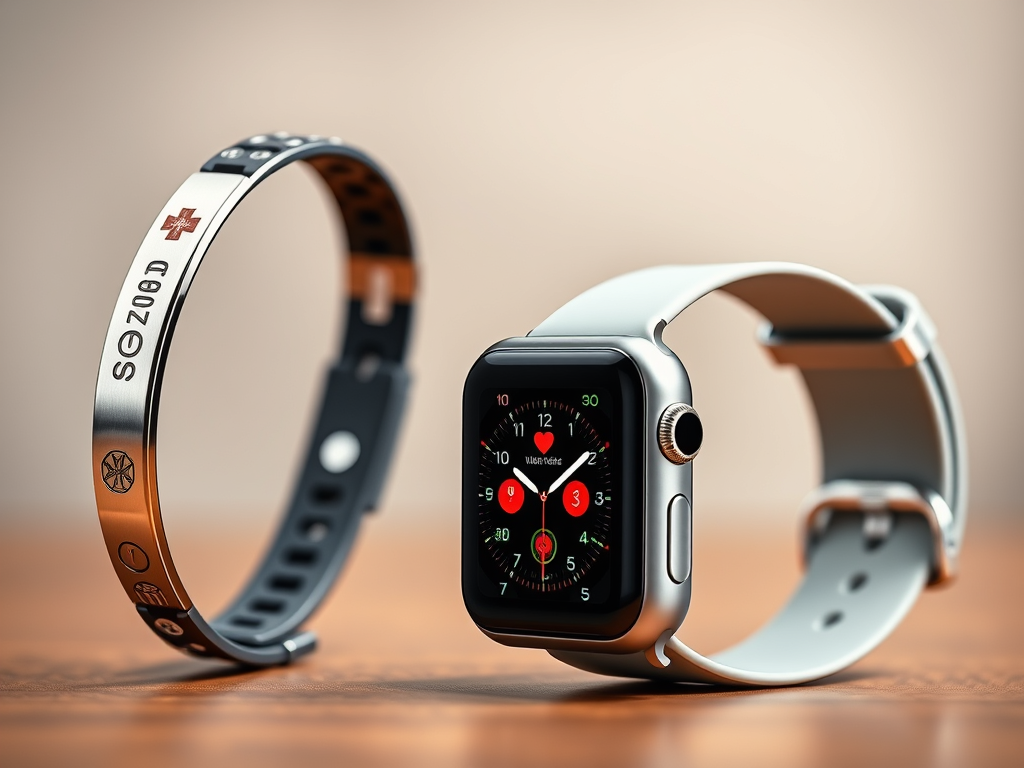
For most people, this is a gadget question. For me, living with intractable epilepsy, it has never been hypothetical. The answer affects what happens to me if I have a seizure somewhere no one knows my name.
I get asked some version of this question often enough that it deserves a real answer instead of a quick one: should you wear a medical ID bracelet, an Apple Watch, or both? The honest answer is that this isn’t really an either-or decision once you understand what each one is actually good at, and where each one quietly fails you.
I wear both. Here is why, and here is what I think you should actually weigh before deciding for yourself.
A medical ID is built to be found. A smartwatch is built to respond. Those are two different jobs, and most people only plan for one of them.
What a Medical ID Actually Does Well
A traditional medical ID bracelet or necklace solves one problem extremely well: it gets noticed by someone who doesn’t know you, doesn’t have your phone, and may have seconds to make a decision. First responders are specifically trained to look for medical alert jewelry on the wrist or neck of an unresponsive person. There is nothing to unlock, charge, or navigate. The information is simply there.
This matters enormously for seizure disorders specifically. The Epilepsy Foundation recommends a medical ID for exactly this reason: if a seizure happens in public and you can’t communicate, the people around you, including bystanders who have no medical training, can use the ID to understand what’s happening and what to do instead of panicking or, worse, doing the wrong thing.
Services like MedicAlert go a step further, pairing the physical ID with a 24/7 record that emergency responders can call into for your full medical history, medications, and emergency contacts. That redundancy is the point. A bracelet can’t fail, run out of battery, or end up in a bag three feet away from you when something happens.
What a Smartwatch Adds That a Bracelet Cannot
A medical ID is purely informational. It tells someone what’s wrong after they’ve already noticed something is wrong. An Apple Watch does something a bracelet structurally cannot: it can notice the emergency itself and act on it without anyone else being present at all.
Fall Detection, available on Apple Watch Series 4 and later, SE, and Ultra models, taps your wrist and sounds an alarm when it senses a hard fall. If you don’t respond and the watch detects you’ve been immobile for about a minute, it begins a 30-second countdown and then automatically calls emergency services on its own, even if you’re alone. After the call, it texts your emergency contacts your location. On newer Ultra models paired with a recent iPhone, Emergency SOS can route through satellite when you’re outside cellular or Wi-Fi range entirely.
That is a meaningfully different kind of protection than identification. A bracelet works once someone finds you. Fall Detection can get help moving before anyone does.
Where the Watch Still Falls Short
None of that makes the watch a replacement. It requires charging roughly every one to two days, and a dead watch protects no one. It isn’t a universally recognized symbol the way a red medical alert emblem is, so a bystander has to know to look at it and know what they’re looking at. And critically, Fall Detection is built around falls. A seizure doesn’t always produce a hard, sudden impact the way a fall down stairs does, so it isn’t a guaranteed seizure-detection system, even though it can still help with the physical fall that sometimes accompanies one.
If you’re weighing the Apple Watch on the merits for health monitoring specifically, separate from this comparison, I’ve gone deeper on the EMF and safety questions people raise about it in Does Your Apple Watch Harm You? Cutting Through the EMF Influencer Claims. And if you’re specifically wondering about dedicated, purpose-built seizure detection wearables that go beyond general fall detection, I cover those in Dedicated Seizure Detection Devices: What Actually Works Beyond a Smartwatch.
The Feature Most People Never Set Up
Here’s something the old version of this comparison got wrong, and it’s worth correcting directly: a smartwatch isn’t entirely invisible to first responders the way I used to think. Both iPhone and Apple Watch include a Medical ID inside the Health app that can be set to display directly on the Lock Screen, fully accessible without a passcode, by tapping Emergency. On the watch itself, holding the side button to reach the power-off screen also surfaces a Medical ID slider with the same information.
That closes part of the gap, but only if you actually set it up and enable Show When Locked, and only if whoever finds you thinks to check. A physical bracelet doesn’t require that extra step of awareness from a stranger. The digital version is real protection. It is just not a substitute for something visible on your skin that needs no explanation.
My Answer After Living With Both
I wear a medical ID and an Apple Watch, and I don’t think of that as redundant. They cover two different failure modes. The bracelet protects me in the scenario where I’m found by a stranger with no device, no context, and no time. The watch protects me in the scenario where no one is around to find me at all.
If you have to choose only one, choose based on which failure mode worries you more. If you’re usually around other people, a medical ID alone covers most of your real risk. If you spend real time alone, especially with a condition that can leave you unable to call for help, Fall Detection closes a gap a bracelet structurally cannot. But for anyone managing a serious chronic condition, the honest, unglamorous answer is that both together cost less than fifty dollars a year combined and cover meaningfully more ground than either one does alone.
Identification gets you noticed. Detection gets you help when no one is there to notice. You don’t have to pick.