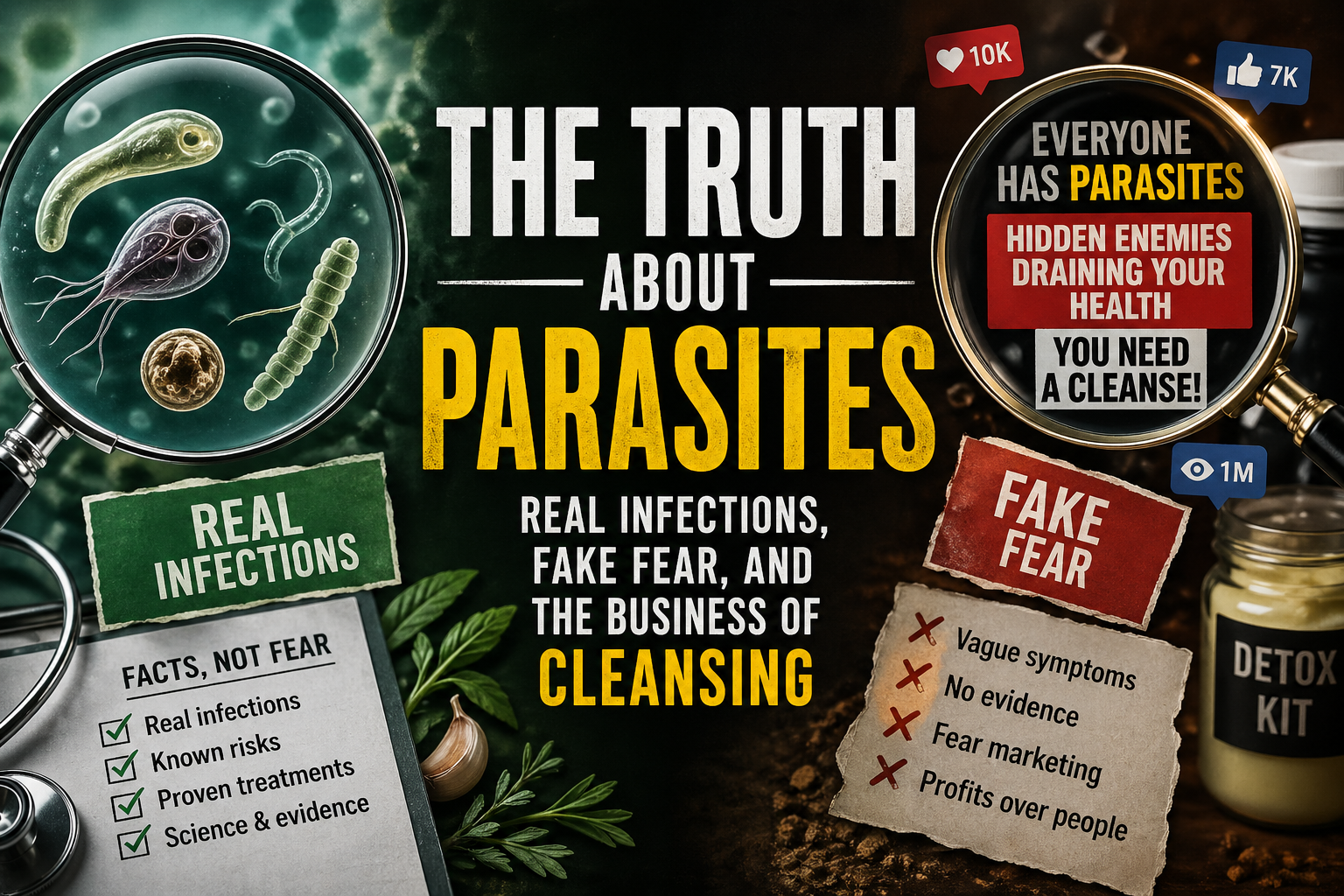
Real parasitic infections exist, but so does a growing industry built on exaggeration, fear, and endless cleansing. In a world flooded with noise, discernment matters more than ever.
Every era seems to produce its own health villain. At one time it was fat. Then carbohydrates. Then gluten. Then mysterious toxins supposedly hiding in every corner of modern life. Today, one of the most profitable villains in online wellness culture is the hidden parasite.
Spend enough time on social media and the message becomes difficult to miss. Fatigue is blamed on parasites. Bloating is blamed on parasites. Brain fog, cravings, skin irritation, poor sleep, anxiety, stubborn weight gain, low motivation, digestive discomfort, and countless other symptoms are rolled into the same explanation. If you are not cleansing once or twice a year, some claim you are quietly losing ground while unseen invaders drain your health.
Conveniently, the solution is usually available through a link in the bio.
That pattern alone should invite a pause.
Real parasites deserve serious attention. Manufactured parasite panic deserves serious skepticism.
In This Article
Parasites Are Real, and Some Can Be Serious
A responsible conversation begins with reality. Parasitic infections are legitimate medical conditions caused by specific organisms with specific routes of transmission, recognizable symptom patterns, and established treatment approaches. They are not mystical concepts or trendy catch-all explanations. They are real biological organisms studied through real science.
Examples include Giardia, often associated with contaminated water and known for diarrhea, cramping, and fatigue; pinworms, which spread easily in households and among children; tapeworms linked to certain food exposures; hookworms that may contribute to anemia and weakness; toxoplasmosis, especially relevant during pregnancy or immunocompromised states; and malaria, which remains one of the world’s major infectious disease burdens.
Taking parasites seriously means understanding them accurately. It does not mean turning every vague symptom into a hidden worm narrative.
Where the Social Media Narrative Breaks Down
The modern parasite trend often depends on sweeping claims that sound compelling but collapse under scrutiny. We are told that everyone has parasites, doctors routinely ignore them, testing is useless, chronic symptoms are usually parasite-related, and recurring cleanses are essential maintenance. This framing is emotionally powerful because it simplifies complexity and gives frustrated people a clear villain.
It is also commercially efficient. If everyone has the problem, everyone needs the solution. If tests cannot be trusted, negative results lose meaning. If disagreement from qualified professionals is framed as ignorance or corruption, skepticism becomes further proof of the claim.
That is not balanced reasoning. It is a closed-loop sales narrative.
Where This Claim Actually Came From
The modern “everyone has parasites” narrative has a fairly traceable origin, and understanding it clarifies a lot about how the claim spread. Much of today’s parasite cleanse culture draws, directly or indirectly, from the work of Hulda Regehr Clark, a Canadian-American author who held a legitimate PhD in zoology but was not a licensed medical doctor. Beginning in the early 1990s, Clark published a series of books — including The Cure for All Cancers and The Cure for All Diseases — arguing that a single intestinal parasite was the root cause of essentially every serious illness, cancer included, and that killing it with a specific combination of herbs, along with a handheld electrical device she called a “zapper,” could reverse the disease.
That claim did not hold up. The scientific and medical community rejected it as unsupported by evidence, and Clark faced real legal consequences, including prosecution for practicing medicine without a license. She died in 2009, according to her own death certificate, of complications from multiple myeloma — a form of cancer.
None of this means every person who has felt drawn to a parasite cleanse today is following Clark’s work knowingly. Most aren’t. But the three-herb combination still marketed today — black walnut hull, wormwood, and clove, sometimes called the “Clark trio” — traces its popularity directly back to her books, and the broader framework of “everything traces back to one hidden cause” that still drives a lot of wellness-industry marketing owes a real debt to the pattern she established.
What’s Actually in These Cleanse Products
The ingredients themselves deserve a fair, specific look, separate from the marketing built around them. Black walnut hull, wormwood, and clove — the three herbs at the center of most parasite cleanse products — each have some genuine antiparasitic activity documented in laboratory and animal studies. Wormwood contains compounds that have shown activity against certain parasites in controlled lab settings; black walnut hull has documented antimicrobial properties; clove’s essential oil compounds have shown some activity against parasite eggs in vitro.
What’s genuinely missing is the next step: rigorous, controlled human clinical trials confirming that these herbs, at the doses and forms sold commercially, actually clear a real parasitic infection in a real person. Laboratory activity against isolated organisms in a petri dish is a meaningfully different claim than proven clinical effectiveness — the same gap that shows up across a lot of unproven wellness claims. That gap doesn’t mean these herbs are worthless. It means the confident marketing language built around them outpaces what the evidence currently supports.
Dosing, sourcing, and quality control also vary enormously between products, with little standardization across the industry. A cleanse built around real, if preliminary, antiparasitic compounds is a genuinely different thing than a cleanse built around vague symptom lists and unfalsifiable claims — worth keeping separate when evaluating any specific product.
Why Many People Feel Better After a Cleanse
Many people genuinely feel better after a cleanse, and that experience should not be dismissed. However, improvement after an intervention does not automatically validate the explanation attached to it.
During many cleanse programs, people reduce processed foods, lower sugar and alcohol intake, increase hydration, add fiber, pay closer attention to digestion, and often become more disciplined in their daily habits. Those changes alone can improve energy, bloating, bowel regularity, and overall well-being. If you want to strengthen the fundamentals that quietly move health forward, read Lifestyle Foundations.
Sometimes the relief is real while the diagnosis is mistaken. That distinction matters because the wrong explanation can keep people buying products instead of sustaining the habits that likely helped them most.
What People Think They Are Seeing
One of the more dramatic parts of parasite cleanse culture is the claim that expelled worms can be visibly confirmed after a cleanse. In many cases, what people interpret as parasites may instead be mucus strands, undigested vegetable fiber, psyllium gel formations, seed husks, stool casts, or residue from herbs and binders.
In simple terms, the cleanse itself can create unusual bowel output that is then used as proof the cleanse was necessary. Most people are not trying to deceive anyone. They are interpreting what they see through a belief system they already accepted.
The Problem With Vague Symptoms
One reason parasite marketing spreads so effectively is that it attaches itself to symptoms millions of people already experience. Fatigue, bloating, constipation, skin issues, brain fog, anxiety, poor sleep, and weight struggles are common in modern life. They are real experiences, but they are also highly non-specific.
Those same symptoms may stem from chronic stress, poor sleep quality, blood sugar instability, nutrient deficiencies, thyroid dysfunction, gut imbalance, sedentary living, dehydration, or a combination of ordinary but powerful lifestyle factors. Electrolyte balance can also matter more than many realize. Read Why Salt Isn’t Bad for You: The Real Story About Electrolyte Balance.
When one fashionable explanation claims everything, people often stop examining what is more common, measurable, and likely.
The Business of Endless Root Cause Hunting
Parasites are only one chapter in a broader pattern. Many people move from one hidden explanation to another in search of a final answer. One season it is toxins. Then candida. Then mold. Then heavy metals. Then hormones. Then some newly branded syndrome suddenly said to explain everything.
Some of these topics contain real truths in specific contexts, but the larger cycle often becomes a marketplace of perpetual searching. Real progress is frequently less dramatic and more consistent: better habits, honest self-assessment, patience, and enough time for fundamentals to work.
What About Testing?
Testing for parasites is not perfect, but it’s considerably more developed than parasite-cleanse marketing tends to acknowledge. The actual clinical workup for a suspected parasitic infection typically involves several tools used together, not a single test taken as the final word.
Stool ova and parasite (O&P) testing remains the standard starting point — direct microscopic examination of stool samples, ideally collected across three separate days, since parasite shedding is intermittent and a single sample can miss a genuine infection. A complete blood count checking for eosinophilia — an elevation in a specific type of white blood cell — is a meaningful clinical clue, since it commonly rises when certain parasites migrate through body tissue. For organisms that are difficult to catch under a microscope, PCR-based stool testing offers considerably higher sensitivity by detecting the organism’s genetic material directly, though it comes with its own limitation: it can’t always distinguish a live, active infection from residual genetic material. Serology — blood testing for antibodies — plays a more targeted role, particularly useful for specific organisms like Strongyloides or for confirming suspected tapeworm-related conditions.
A single negative stool test does not definitively rule out an infection, which is a real and fair limitation. But the fact that testing has limitations does not logically mean everyone is infected, or that testing should be dismissed entirely in favor of symptom-based self-diagnosis. That leap is where honest nuance often gives way to profitable storytelling.
What a Smarter Approach Actually Looks Like
One of the clearest signs that parasite culture has gone off course is that many people begin with cleansing instead of diagnosis. They start rotating herbs, buying binders, and interpreting every digestive sensation as evidence of die-off before first asking the most basic question: is a parasitic infection actually likely?
That question matters more than any product stack. Meaningful suspicion usually involves context. Persistent diarrhea, unexplained weight loss, abdominal pain, anemia, visible worms or segments in stool, contaminated water exposure, significant travel history, or certain laboratory abnormalities create a very different picture than vague fatigue and occasional bloating in an otherwise common modern lifestyle context.
When genuine concern exists, a more rational path is proper testing and clinical evaluation using the diagnostic tools described above, guided by a qualified professional.
Natural support still has value. Hydration, nutrient-dense food, regular bowel movements, fiber when tolerated, garlic and ginger as foods, reduced ultra-processed intake, and better sleep can all support digestive resilience and recovery. For foundational strategies that matter beyond trends, read Lifestyle Foundations.
The wiser sequence is simple: identify the issue, treat specifically when necessary, then rebuild health intelligently. That approach lacks drama, but it offers something far more useful than drama: logic.
What Evidence-Based Treatment Actually Looks Like
When a parasitic infection is genuinely confirmed, treatment looks nothing like a general-purpose herbal cleanse — it’s organism-specific, with real clinical trial evidence behind the medications used. Albendazole and mebendazole are broad-spectrum options with well-documented effectiveness against many intestinal worms. Praziquantel is the standard treatment for tapeworm-related infections. For malaria, treatment depends on the specific species and regional resistance patterns, typically involving artemisinin-based combination therapies.
One condition worth naming directly, given this site’s focus on neurological health: neurocysticercosis — infection of the brain by the larval stage of the pork tapeworm, Taenia solium — is one of the most common preventable causes of acquired epilepsy worldwide, particularly in regions where the infection is endemic. It’s treated with albendazole, sometimes combined with praziquantel for cases involving multiple cysts, alongside careful management of inflammation and seizure activity by a multidisciplinary medical team. This is a genuine, well-documented example of a real parasitic infection causing real seizures — a meaningfully different claim than the vague, symptom-agnostic version of “parasites cause your health problems” that circulates in wellness marketing, and a good illustration of why precision matters here rather than blanket claims in either direction.
The broader point holds across every organism: targeted, evidence-based treatment for a confirmed infection typically accomplishes more in days or weeks than months of rotating herbal products ever could.
Navigating This With a Skeptical Doctor
Physicians have genuinely good reason to be cautious when a patient raises parasite concerns, given how often the topic arrives wrapped in wellness-industry framing rather than clinical specifics. Getting a fair hearing usually comes down to bringing the right information rather than the symptom list alone.
Specific, concrete details carry far more weight than general complaints: a specific travel history, particular water exposure, undercooked meat or fish consumption, a household member with a diagnosed infection, or a relevant occupational or immunocompromised status. Asking directly and specifically for stool O&P testing, or naming a specific organism of concern based on genuine risk factors, tends to be received very differently than a general request to “test for parasites” driven by a symptom checklist from social media.
If real risk factors exist and a physician still declines reasonable testing, a second opinion is a legitimate option. The goal throughout is precision, not persistence for its own sake — showing up with a specific, well-reasoned concern rather than a general fear.
Parasites and Cancer Claims
Certain chronic parasitic infections can increase cancer risk in specific geographic and medical contexts. That is real science. Yet this truth is often exaggerated into sweeping claims that parasites are the hidden cause of most cancer, or into viral claims that anti-parasitic drugs like fenbendazole can cure cancer that’s already present.
This particular corner of the topic is contested enough, and consequential enough, that it deserves its own dedicated, careful treatment rather than a brief mention here. Read the full breakdown in Do Parasites Cause Cancer? The Real Science Behind a Highly Contested Claim — including the actual documented IARC-classified links, where the viral fenbendazole story really comes from, and what the current evidence does and doesn’t support.
How to Think More Clearly
A wiser way to approach health claims is through probabilities rather than absolutes. If someone sleeps poorly, lives under constant stress, rarely moves, eats inconsistently, and has no meaningful exposure risk, lifestyle strain is often a more probable explanation than hidden parasites. If someone develops persistent digestive illness after contaminated water exposure or international travel, infection becomes a more relevant possibility.
Context matters. Risk factors matter. Common things are common. Rare things do happen, but they should not automatically become the first explanation for ordinary symptoms.
Why People Chase These Answers
Many people drawn to parasite narratives are not foolish. They are frustrated. They may feel dismissed, chronically unwell, or tired of vague answers. When someone has struggled long enough, certainty itself can feel therapeutic.
That deserves compassion. But being failed by one system does not mean the next confident voice automatically deserves trust.
Natural Support Has Value, But It Is Not Everything
Natural strategies can absolutely support health. Hydration, fiber, garlic, ginger, nutrient-dense food, movement, better sleep, stress reduction, and healthy digestion all matter. These are worthwhile practices whether parasites are relevant or not. For a practical real-world example, read Supplements I’ve Tried: What Stayed, What Went, and Why.
At the same time, support is not always the same as treatment. When a confirmed infection exists, targeted medical care may be appropriate. Wisdom usually lives between extremes, not inside them.
The Twice-a-Year Cleanse Question
Ask a simple question: who benefits from the belief that everyone needs recurring parasite cleansing forever? There is no universal law requiring all healthy adults to purge parasites every six months. What does exist is a polished business model built around repeat customers, urgency cycles, and maintenance marketing.
Who Is Actually at Higher Risk?
Meaningful risk may be higher with contaminated water exposure, certain international travel, sanitation-limited environments, undercooked meat habits, household pinworm outbreaks, or immunocompromised states. That is a more honest framework than telling every tired adult their symptoms are probably parasites.
FAQ
If my stool test comes back negative, does that mean I definitely don’t have a parasite?
Not with complete certainty — a single negative sample can miss an infection, which is why repeat testing or additional methods like PCR may be used when genuine risk factors are present. It does mean, though, that a negative result carries real weight and shouldn’t be dismissed simply because it doesn’t confirm the suspected answer.
Can herbal cleanses work at all, or are they completely useless?
The individual herbs in most cleanse products have some documented antiparasitic activity in lab and animal studies — that part isn’t fabricated. What’s missing is rigorous human clinical evidence that commercial products, at typical doses, reliably clear a real infection. That gap is worth taking seriously rather than assuming either extreme.
Is it ever reasonable to do a cleanse without a confirmed diagnosis?
That’s a personal decision, but it’s worth being honest about what it actually is — a general wellness practice rather than treatment for a diagnosed condition. Framing it that way, rather than as parasite treatment, keeps expectations accurate.
Why Discernment Matters Now More Than Ever
We live in an age where nearly any belief can be reinforced with enough searching. Someone convinced everyone has parasites can find endless confirmation. Someone convinced parasites never matter can find support for that too. Information is abundant. Wisdom is not.
Education remains one of your best allies, but modern education must include discernment. It requires asking who benefits, what evidence exists, and whether simpler explanations were honestly considered.
The Bottom Line
Real parasitic infections exist and should be taken seriously. So should the growing culture of parasite fear that exaggerates risk, oversimplifies symptoms, and sells recurring cleansing as the answer to nearly everything.
You do not need blind trust in institutions. You do not need blind trust in influencers. You do not need another cycle of fear disguised as wellness.
You need clearer thinking, better questions, and enough discipline to honor the basics that quietly build health over time.
In a world where confusion is profitable, clarity is protective.
Want the complete Detox Foundations Guide?
What detox foundations actually mean, exactly where to focus first, and what to skip entirely, all in one free guide.
Related Reading
Lifestyle Foundations — The habits that quietly shape long-term health.
Supplements I’ve Tried: What Stayed, What Went, and Why — A practical look at intentional support strategies.
Natural Vitality Advocate — More articles on health, healing, and clear thinking.
Sources & Further Reading
Centers for Disease Control and Prevention (CDC) — Parasites overview, Giardia, Pinworm, and prevention resources.
World Health Organization (WHO) — Malaria burden and neglected tropical disease resources.
National Institutes of Health / PubMed — Research literature on parasitic infections and diagnostics.
Merck Manual Professional Edition — Approach to Parasitic Infections, diagnostic and treatment reference.
International Agency for Research on Cancer (IARC) — Infection-related carcinogen classifications.
Mayo Clinic — Patient-friendly education regarding symptoms, diagnosis, and treatment approaches.
Disclaimer
Natural Vitality Advocate provides educational, experience-informed wellness content and does not diagnose or treat disease. This article discusses general medication classes for educational context and is not a treatment recommendation. If you suspect a genuine parasitic infection or ongoing illness, consult a qualified healthcare professional.